• Welcome to the Open Risk Academy

    Here we forge the open source future of risk management!

    The Academy offers a unique range of online eLearning resources spanning and integrating the range of Data Science, Sustainability and Risk Management

    Courses are split into technical (involving mathematics or programming) and non-technical.

    Search for a topic of interest or simply scroll down the page to find an interesting course!

    Access to the courses is free but you must request an account along with your motivation. Alas there is no other way to contain spam accounts. Please do not share your account with others. It is both a security risk and diminishes the functionality of the platform.

    If you find our public and free resources useful consider donating to support their ongoing maintainance and development!


Courses


Academy News

The Open Risk Manual is now open to Academy users

by Ad Min -

The Open Risk Manual was developed for a long time, with out-most conviction, as an open and free resource. An open online repository of information about Risk Management in all its forms, that was the core idea, part of our vision for widely available open source tools for risk management and sustainable finance.

Alas, as of late the open part of the mission has become very problematic. A large number of AI bots are now roaming the internet and hitting servers (like the one on which the Manual runs) indiscriminately, without regard to breaking it. It has become very difficult to defend against such (effectively) DDoS attacks. Filtering the thousands of hostile bot requests using random address from human users is not what we want to spend our resources on. After trying all possible measures, it became clear that nothing will do. We need to ask users of the Manual to login before browsing and/or searching. 

The login mechanism is the same as the Academy. Users of the Academy can already use the Manual using their existing credentials. Other users will need to setup and have an account approved at the Academy.

Mathematical Formulation of Financial Statements

by Ad Min -

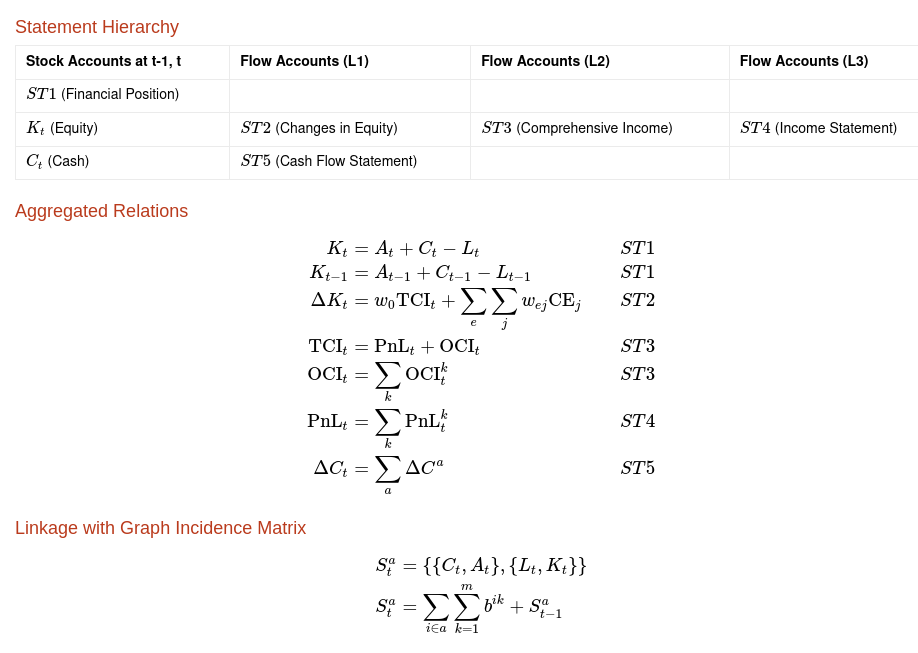
Our objective in this post is to express standard financial statements concisely using symbolic mathematical notation that substantially captures their numerical information content and the constraints being satisfied.

We use the incidence matrix of an accounting graph to describe an abstract underlying accounting system that follows double-entry bookkeeping principles and we derive from it the classification, aggregation and stock-flow machinery that reproduces the well-known balance sheet, income and cash flow statements.

Open Risk White Paper 19: Connecting the Dots: Accounting Graphs for Double and Quadruple-Entry Bookkeeping

by Ad Min -

In a new paper we develop the concept of an accounting graph as an intuitive and flexible tool that can faithfully represent widely used accounting concepts.

graph

More specifically, a weighted directed multigraph representation is applied to model standard double-entry bookkeeping (DEB) of individual accounting entities but extended to also provide a consistent accounting graph for larger economic networks that feature multiple transacting entities (so-called quadruple-entry accounting). We illustrate the concepts with stylized accounting examples. Such accounting graphs are promising both as educational tools and towards the application of computational tools on accounting data.

White Paper 18: Sustainable Public Procurement, Part II, Making Use Of Environmentally Extended Input-Output Data

by Ad Min -

Adopting Open Data and Open Source tools can be a catalyst in the sustainability transition and Green Public Procurement (GPP) is a particularly opportune domain to explore this potential. In the first paper in this series we outlined key information flows and tasks that are relevant in this context. Here we dive deeper into how one can leverage a particularly promising source of economic and environmental impact information: Environmentally Extended Input-Output (EEIO) databases. We will discuss some of the challenges that must be addressed to effectively use EEIO tools in GPP, especially in European context. The use cases in focus are: how to produce an overall inventory of direct and indirect emissions for different procurement categories, and how to differentiate between green and non-green products. Some practical problems that must be tackled are: the consistent linkage of procurement data sets to EEIO databases, and the disaggregation of EEIO sectors to more granular of green / non-green products. We discuss potential approaches and their pros and cons. We analyze the specific challenge of creating a CPV-NACE mapping that would link demand driven procurement product taxonomies with supply driven economic activity classifications. We outline a methodology for disaggregating EEIO business sectors to constituent product categories with differentiated environmental impact while preserving the accounting constraints satisfied by the aggregate databases.

Portable Standardized Graph Formats for Input-Output Databases

by Ad Min -

There are currently several important global initiatives that compile and make available statistical economic input-output data (IO). This is done typically on a multi-regional basis (covering many countries and regions, hence MRIO) reflecting the fact that international trade is (still) very much a reality. Environmentally extended input-output (EEIO) databases that are in turn based on economic activity IO data, are increasingly used to examine environmental footprints of economic activities and play an important role in the attribution and screening of regional and sectoral contributions to environmental stresses.

Yet there is a lot of diversity and complexity in the organization of these typically large datasets. This complicates the adoption and use of EEIO, as it requires the dedication of time and effort to acquire and process data, both initially and potentially with any updates. Motivated by this context, we discuss a simple, generic and portable format for disseminating Input-Output data. The format is inspired from the Graph representation of Input-Output matrices. It allows a unified and very extensible description which can be serialized into standard csv files but also inside a minimal portable sqlite database file.

What can Inka Quipus teach us about data management?

by Ad Min -

A blog post about the ingenious methods used by the ancient Inca culture to encode information and what insights we might draw from them today for .

The value of metadata, human readibility, schema flexibility and append-only ? Its all there!

Older topics...